A Shade Above started out of necessity, in a garage, with more ambition than square footage.
It began with three dental offices that had brought milling equipment in house, hoping to produce their own restorations instead of sending everything out. What started as a hobby during the COVID days of 2020 turned into something viable — a way for those three practices to cut the middleman out of their restorative work entirely.
From there we grew, and we kept investing internally: better machines, better materials, the capability to make just about anything those offices needed. Now we have the equipment and the people to run it. What we need is the business to keep it all turning.
We still work out of a modest space in Northeast Ohio, and that's a decision rather than a circumstance. Every time we've had money to put somewhere, it went into the mills, the furnaces, the printers, or the material on the shelf. It has never gone into a lobby, a showroom, or a sales team.
That's the whole philosophy, and it has a practical consequence: our prices are lower than they'd otherwise be, and the quality of what leaves here is not. We buy the same materials the large labs buy — Ivoclar and Amann Girrbach, with no budget alternative on the shelf — and we run them on equipment chosen because it produces work we'd be willing to put in our own patients' mouths.
No layers
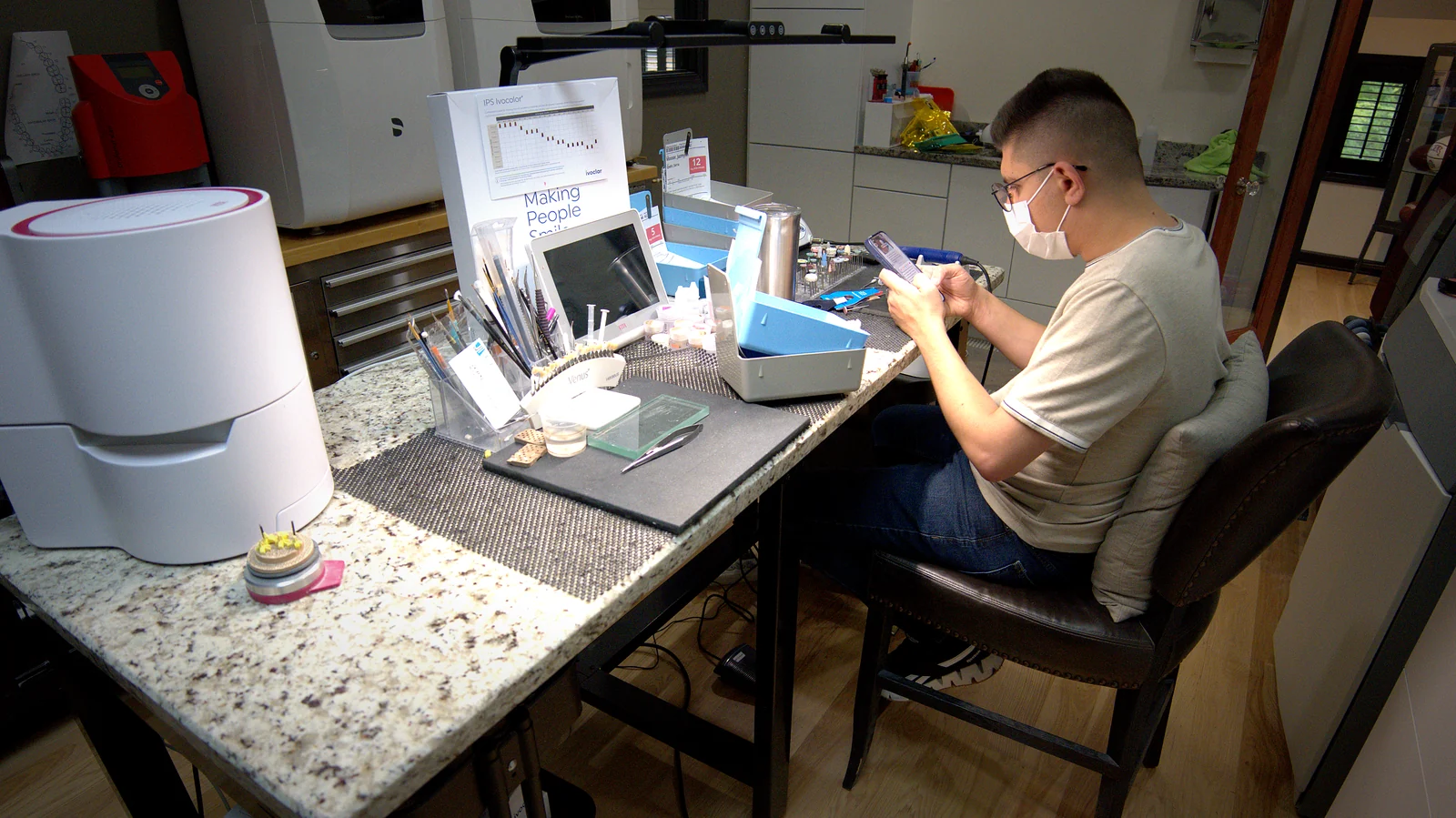
There are exactly two of us. One designs, one runs the machines, and between us we have decades in this industry — one raised in a house with two dentists in it, the other with more than ten years at a laboratory bench here and overseas. That is the entire company, and it is the reason nothing gets lost between the order form and the bench.
What that means for your office is simple. When you call with a question about a case, you are talking to the person who is going to make it. Not a coordinator taking a message. Not a rep who'll pass it along. If your patient has asked for something particular about the shape, the shade, or the contour, tell us directly and we'll build to it — and if we think it won't work, we'll say so before we mill instead of after you've tried to seat it.
What we're actually asking for
We're not going to dress this up. We're a young lab looking to build a client list, and we know the only way to do that is to be better and faster and more reasonable than whoever you're using now.
So the offer is honest: send us one case. Ask us about the first one — we make it easy for a new office to find out whether we're worth switching to. If our price doesn't work for your practice, tell us what does and we'll see how close we can get. And if you're anywhere in Northeast Ohio, we'll drive out and pick it up ourselves.
What we're after isn't a stack of one-off cases. It's a handful of offices we work with for years — close enough to drive to, small enough that you're not a ticket number, and priced so that staying with us keeps making sense.
That's it. That's the pitch.